Tests
1. Evaluation of central nervous system condition based on standard senso-motoric reaction.
The basis of method is analysis of senso-motoric reaction level and stability in response to light irritation. Light impulses (lightning of green light) on front panel of device are used as a stimulus. Stimuli are exposed sequentially. Test consists of 35 or 75 (depending on scenario) light stimuli in green color, first 5 are meant for training and doesn’t count in parameter calculation. During the test, response time (ms) and amount of false actions (signal skipping, pressing too soon) are registered. At the end of test: average response times, average standard deviation, amount of rashness and delay failures are being calculated.
2. Evaluation of operator action level on basis of complicated sight motoric reaction.
As stimuli (light irritators) two color (red/green) indicators are used. Stimuli are exposed sequentially, in unintentional order. Amount of stimuli is 75 or 35. Response time and false actions (wrong answer, signal skipping, pressing too soon) are registered.
3. Complicated sight motoric reaction with selection of two alternatives in three phases.
Method is based on second point but includes three phases, which allows collecting wider information range about interpretation of operator action appropriateness. Aim – evaluation of nervous process basic qualities: irritation process strength, delaying process strength, nervous process mobility.
4. Test “AD” or “Adjustment disorders” is created to evaluate adjustment disorders of patient. With help of automatic conclusion generation, programs gives a possibility to find out whole scene and allows professional psychologist make deeper research and evaluate adjustment disorders for individual person and group of people as well.
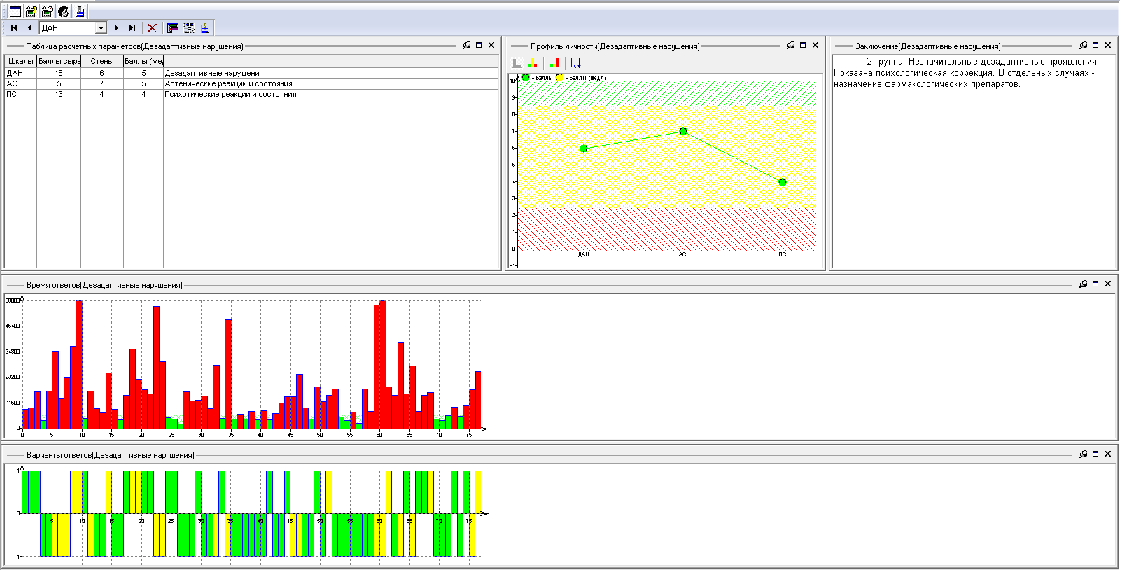
Statistic diagrams acquired in time of “Adjustment disorders” test